
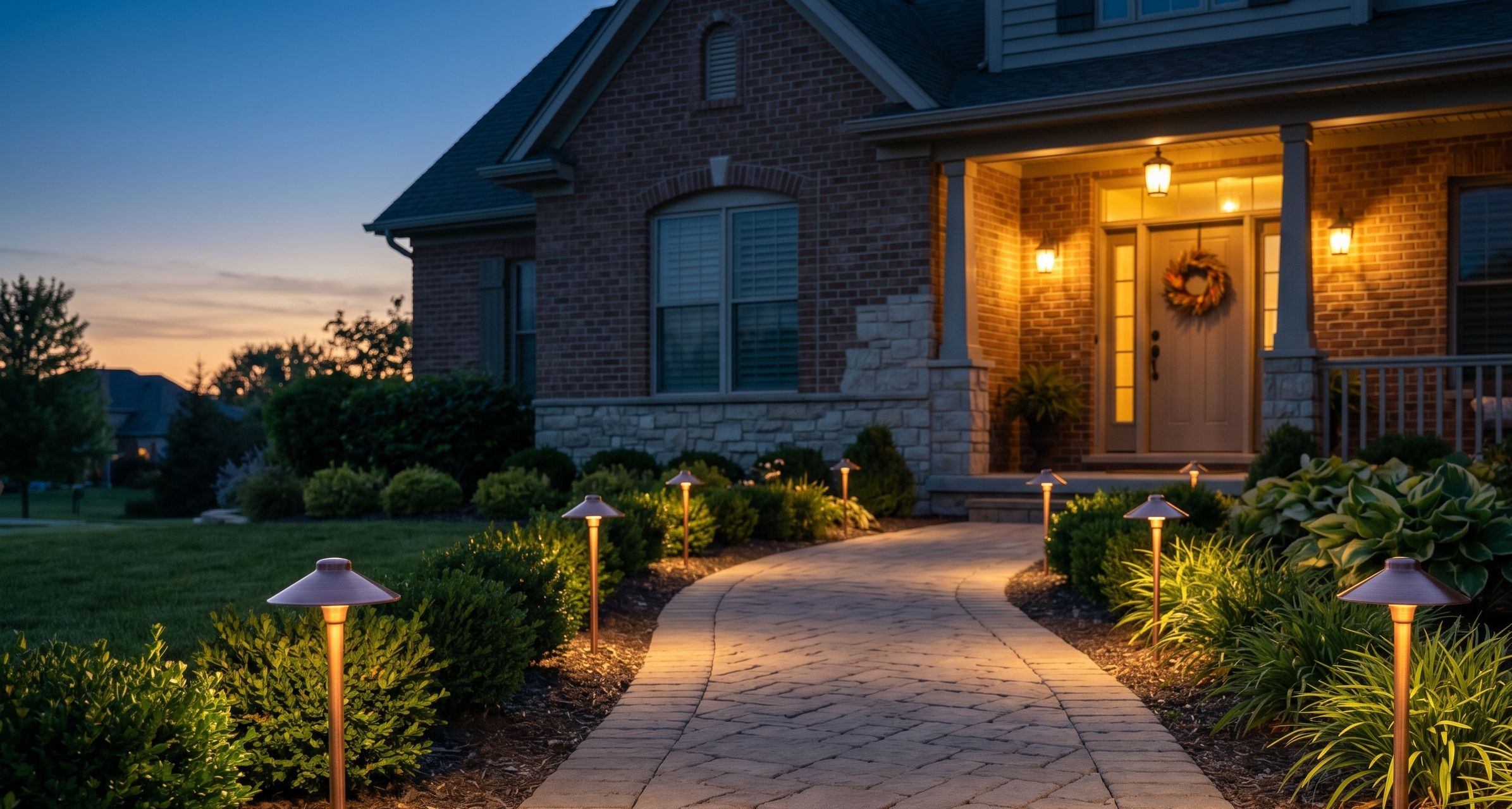
Your front walkway is the most walked and most watched path on your property. It is the route guests take to your front door. It is what you see every time you come home after dark. And it is one of the first things potential buyers notice when they pull up to a listing.
A well lit front walkway does two things at once. It makes your home safer to approach at night, and it makes your home look polished, warm, and intentional from the street. That combination of function and beauty is what curb appeal is all about.
But there is a line between “beautifully lit” and “blinding everyone who walks by.” Cross that line and your walkway becomes a nuisance instead of an asset.
Here is how to get the lighting right.
Why the Front Walkway Matters More Than You Think
The front walkway is your home’s handshake. It is the transition from the public space (the street, the sidewalk, the driveway) to the private space (your front door). The way that transition feels at night sets the tone for the entire property.
A dark walkway leading to a dark front door feels unwelcoming, even if the house is beautiful during the day. A walkway lined with cheap solar stake lights that flicker and fade feels neglected. A walkway flooded with bright white light feels harsh and uncomfortable.
A walkway with warm, well-spaced pathway lighting that guides you gently to a softly lit front door feels like arriving somewhere special. That feeling is what drives curb appeal.
Start With the Right Fixture Height
For front walkways, fixture height matters more than people realize. Too short and the lights get buried behind the first season of plant growth. Too tall and they start to feel like miniature street lamps that overpower the walkway.
For most front walkways, fixtures in the 15 to 20 inch range hit the sweet spot. They stand tall enough to cast light across the full width of a standard 3 to 4 foot walkway, and they sit low enough to blend with typical foundation plantings and border beds.
If your walkway is flanked by taller plantings like boxwoods, ornamental grasses, or hydrangeas, lean toward the taller end of that range so the fixtures stay visible above the foliage. If the walkway borders a clean, low-maintenance bed with ground cover or mulch, shorter fixtures work fine.
Spacing That Feels Natural
The standard spacing for front walkway path lights is 8 to 10 feet between fixtures. At that distance, the pools of light from adjacent fixtures overlap slightly on the ground, creating continuous illumination with no dark patches.
For a typical front walkway that runs 25 to 40 feet from the driveway to the front door, that translates to roughly 3 to 5 fixtures total. That is not many, and that restraint is part of what makes the result look good. You want just enough light to define the path and guide the eye, not so much that the walkway looks like it has its own power grid.
The staggered alternating layout, where fixtures alternate from one side of the path to the other, is the most popular choice for front walkways. It avoids the rigid, formal look of matched pairs while still providing balanced coverage from both sides.
The Glare Problem (and How to Solve It)
Glare is the number one enemy of good pathway lighting. It happens when you can see the light source directly, either because the fixture is poorly designed, poorly aimed, or too bright for its location.
On a front walkway, glare creates two problems. For the person walking the path, a glaring fixture at eye height is uncomfortable and actually makes it harder to see the ground around it because your pupils constrict in response to the bright point of light. For your neighbors across the street, a row of glaring fixtures aimed outward turns your walkway into a light show that shines into their windows and yard.
Here is how to eliminate glare.
Use shielded fixtures. Quality path lights have a hat, hood, or shade that blocks the bulb from direct view. The light exits downward onto the ground, not outward into people’s eyes. If you can see the bulb when standing upright near the fixture, the fixture is not properly shielded.
Choose the right lumen output. A path light does not need to be bright. For most front walkways, fixtures in the 100 to 200 lumen range provide plenty of light. Going higher than that creates hot spots on the ground and increases the chance of light spilling beyond the path into neighboring properties.
Stick with warm color temperature. Warm light at 2700K is less visually intrusive than cool white light. It glows rather than glares. Your neighbors will barely notice warm pathway lighting from across the street, but they will absolutely notice cool white spotlights.
Angle fixtures inward, not outward. If your fixtures have any directional element, make sure the light is aimed toward the walkway surface, not toward the street or neighboring homes.
Connecting the Walkway to the Front Door
The walkway does not exist in isolation. It leads somewhere, and that destination needs to be lit too. A beautifully illuminated path that ends at a dark front door is anticlimactic. The eye follows the light and arrives at nothing.
The front door area should have its own lighting, whether that is a porch light, a pair of sconces, or downlights recessed into the porch ceiling. The key is making sure the brightness at the door is slightly higher than the brightness along the path. This creates a natural progression: you walk from gentle pathway lighting into a slightly brighter entry zone, which feels welcoming and logical.
If your front door has architectural features like columns, sidelights, or a decorative surround, accent lighting on those elements ties the walkway lighting into the overall landscape lighting plan and gives the arrival sequence a finished look.
Connecting the Walkway to the Driveway
The other end of the walkway matters too. Where the path begins at the driveway or sidewalk, a fixture on each side of the junction marks the starting point and tells visitors where to go.
This is especially important for homes where the walkway is not immediately obvious from the street. If a guest parks at the curb, they need to be able to see where the path begins and follow it to the door. Two fixtures flanking the start of the walkway act as a visual welcome sign.
If you have driveway lighting as well, make sure the transition between the driveway lights and the walkway lights feels smooth. The spacing, brightness, and color temperature should be consistent so the eye moves naturally from one zone to the next without a jarring change.
What About Solar Path Lights?
Solar path lights are the most commonly purchased pathway lighting product, and they are also the most commonly disappointing one.
The appeal is obvious. They are cheap, they require no wiring, and they install in minutes. But the performance rarely lives up to the promise.
Solar path lights depend on direct sunlight to charge their batteries. On cloudy Indiana days (which are frequent, especially in fall and winter), the batteries do not fully charge and the lights either dim early in the evening or do not turn on at all. After a few seasons, the batteries degrade and hold less charge regardless of sunlight.
The light output is also much lower than wired LED fixtures. Solar lights produce a faint glow that looks acceptable when they are new but becomes barely visible as the components age. And because they are mass produced at a low price point, the fixtures themselves tend to fade, crack, or fog within a year or two.
For a front walkway where curb appeal matters, solar lights are a temporary fix at best. They do not deliver the consistent, reliable, warm illumination that makes a front walkway look professionally lit.
Landscaping and Lighting Working Together
The best front walkway lighting integrates with the plantings around it. Fixtures placed within garden beds rather than right at the edge of the pavement look more natural and intentional. The plantings soften the base of the fixture during the day, and at night the light spills onto both the path and the surrounding foliage, creating a warm frame around the walkway.
If your front beds include evergreen shrubs, the lighting will look consistent year round. If the beds include perennials that die back in winter, plan your fixture placement so the lights are still visible and functional when the plants are dormant.
Also consider how the path lights interact with any tree lighting or facade lighting in the front yard. All of these elements should feel like part of the same plan, using the same color temperature and a complementary level of brightness. A front yard where the tree lights are warm white and the path lights are cool white looks disjointed, even if each element is well done on its own.
The Curb Appeal Payoff
A front walkway that is properly lit does something subtle but powerful. It tells everyone who sees your home at night that someone cares about this property. The details are right. The approach is inviting. The home looks its best.
That impression translates directly into curb appeal, whether you are selling your home or simply enjoying it. And because front walkway lighting is one of the more affordable components of an outdoor lighting plan, the return on investment is strong.
Light Your Front Walk the Right Way
At Serenity Outdoor Lighting, the front walkway is one of the first things we address in every design. It sets the tone for the entire property, and getting it right makes everything else work better.
If your front walkway is dark, underlit, or lined with fading solar stakes, we can help. Request a free quote or contact us to see what a professional walkway lighting plan looks like for your home.
