
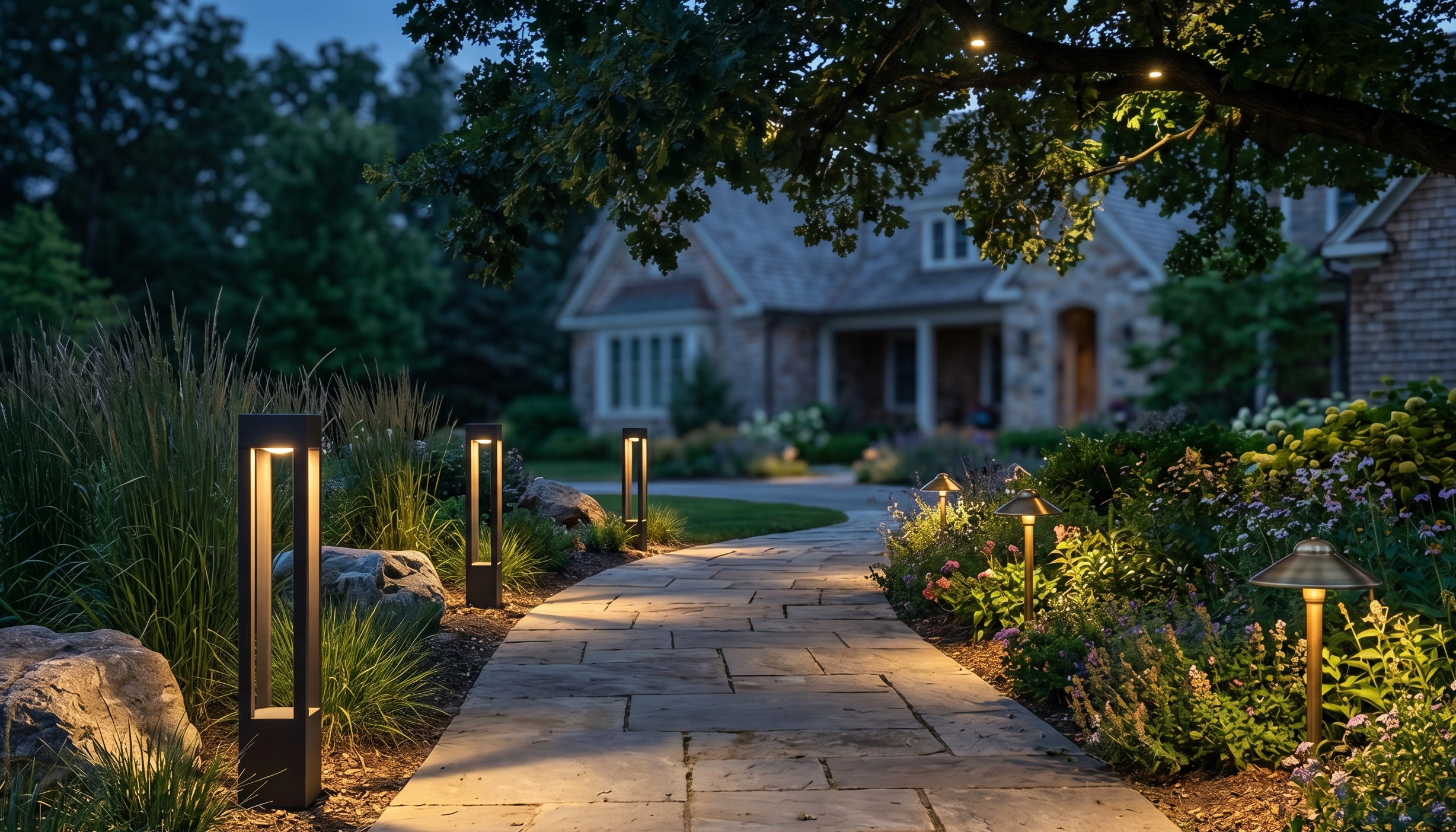
Once you decide to add pathway lighting to your property, the next question is which type of fixture to use. And there are more options than most homeowners realize.
The three most common categories for lighting walkways and paths are bollard lights, garden lights (also called path lights or mushroom lights), and downlights mounted above the path. Each one distributes light differently, looks different in the landscape, and works best in different situations.
Choosing the right one is not about picking whichever looks nicest in a catalog. It is about matching the fixture type to the specific path, the surrounding landscape, and the overall look you are going for.
Here is how each option works and where it fits best.
Bollard Lights
What They Are
Bollard lights are short, vertical posts that stand anywhere from 24 to 42 inches tall. They are cylindrical or rectangular in shape and emit light from a window, slot, or diffuser panel in the side of the post. Some cast light in a full 360-degree pattern. Others are shielded to direct light in one direction or downward only.
Bollards have a distinctly architectural look. They feel structured, clean, and modern. You see them frequently in commercial settings like office campuses, hotel walkways, and public parks, but they work in residential settings too when the style is right.
How They Distribute Light
Because bollards stand taller than traditional path lights, they cast light over a wider area. A single bollard can illuminate a circle of six to eight feet or more, depending on the output and the design of the diffuser.
The trade-off is that taller fixtures are more visible in the landscape. They stand above most ground cover and low plantings, which means they become part of the visual composition whether they are on or off. During the day, bollards are noticeable elements in your yard. That can be a positive or a negative depending on your aesthetic goals.
Where Bollards Work Best
Wide paths and driveways. The broader light spread of a bollard makes it well suited for wider surfaces where a low path light might not throw enough light to reach from edge to edge.
Modern and contemporary homes. The clean, geometric shape of bollard fixtures pairs well with modern architecture, minimalist landscaping, and hardscaped yards. If your home has clean lines, flat roofs, concrete or steel accents, or a contemporary aesthetic, bollards will feel at home.
Commercial-to-residential transitions. If your property has elements that bridge commercial and residential, like a long paved driveway, a courtyard entry, or a formal approach to the front door, bollards can give those areas a polished, intentional look.
Where Bollards Fall Short
Bollards can feel out of place on traditional or rustic properties. A colonial-style home with mature gardens and natural landscaping will look odd with sleek metal posts lining the walkway. The fixture fights the character of the property instead of complementing it.
They can also feel imposing in tight spaces. A narrow garden path flanked by bollards that stand three feet tall can feel like you are walking through a corridor rather than a garden.
Garden Lights (Path Lights)
What They Are
Garden lights are the classic pathway fixture. They consist of a low post (typically 12 to 20 inches tall) topped with a hat-shaped or mushroom-shaped shade that directs light downward. The shade shields the bulb from view, so you see the pool of light on the ground rather than the light source itself.
This is the fixture most people picture when they think of pathway lighting. It is the most popular choice for residential applications, and for good reason.
How They Distribute Light
Garden lights cast a soft, contained circle of light directly beneath them. The shade prevents the light from shooting outward or upward, which eliminates glare and keeps the illumination focused on the walking surface.
The pool of light from a single garden fixture is smaller than what a bollard produces, typically four to six feet in diameter. This means garden lights need to be spaced closer together (8 to 10 feet is standard) to create continuous coverage along a path.
The lower profile of these fixtures means the light stays close to the ground. This creates a warm, intimate feel that works well in garden settings and alongside plantings.
Where Garden Lights Work Best
Front walkways. The classic front-of-home path from the driveway to the front door is where garden lights shine. They look proportionate to the walkway, they blend into surrounding plantings, and they create a welcoming glow that leads guests to the door.
Garden paths. Any path that winds through landscaped areas, garden beds, or natural plantings is a natural fit for garden lights. The fixtures sit at the same height as many plants and shrubs, integrating into the landscape rather than standing above it.
Traditional and transitional homes. Garden lights suit virtually every residential architectural style except the most aggressively modern. They look equally appropriate on a craftsman bungalow, a colonial, a ranch, or a farmhouse.
Curved walkways. Because garden lights are small and unobtrusive, they follow curves gracefully. A line of garden lights tracing a winding path through the yard creates a beautiful flow of light that highlights the shape of the path.
Where Garden Lights Fall Short
On very wide paths or driveways, garden lights may not throw enough light to reach across the full surface. Their focused, downward distribution is a strength in narrow paths but a limitation on broader surfaces.
They can also get lost in tall, dense plantings. If the garden beds along the path are filled with tall perennials or thick shrubs, a 14-inch-tall fixture can disappear behind the foliage, blocking its light and making it invisible.
Downlights
What They Are
Downlights are fixtures mounted above the path rather than beside it. They attach to trees, pergola beams, eaves, fence posts, or any elevated structure that overhangs the walking surface. The light aims downward, illuminating the path from above.
Downlights are not standalone fixtures. They depend on existing structures or mature trees to provide a mounting point. This makes them a technique-dependent option rather than a fixture you can place anywhere.
How They Distribute Light
Mounted at height, downlights cast a broad, even wash over the ground below. The effect is similar to moonlight: soft, diffused, and natural looking. If the light is mounted in a tree, it filters through branches and leaves, creating dappled patterns on the path.
Because the light source is far from the ground, downlights cover a larger area per fixture than ground-level options. A single well-placed downlight in a tree might illuminate 15 to 20 feet of path, which means you need fewer fixtures overall.
Where Downlights Work Best
Paths beneath mature trees. If your walkway passes under large trees, downlighting from the canopy is one of the most beautiful ways to light it. The fixture hides in the tree, the light feels natural, and the path below gets even, glare-free illumination.
Covered paths and pergola walkways. Any path with a structure overhead is a candidate for downlighting. Pergolas, arbors, covered breezeways, and portico ceilings all provide natural mounting points for downlight fixtures.
Areas where ground fixtures are impractical. Some paths have conditions that make ground-level fixtures difficult. Paths cut into rock, paths with very narrow borders, or paths along retaining walls may not have room for a post-mounted fixture beside them. Downlighting from above solves the problem without requiring any ground space.
Properties going for a natural look. Because downlights hide above eye level, they create light without visible fixtures at ground level. The path appears to glow on its own, which appeals to homeowners who want an organic, uncluttered look in their landscape.
Where Downlights Fall Short
The obvious limitation is that you need something to mount them on. If your path runs through an open lawn with no trees, no structures, and no overhangs, downlighting is not an option unless you add a post or pole specifically for that purpose, which can look forced.
Downlights mounted in trees also require periodic adjustment as the tree grows. Branches shift, canopies fill in, and the light pattern changes over the years. A fixture that cast a perfect pool of light on the path three years ago may now be blocked by new growth. Professional maintenance visits can address this, but it is an ongoing consideration.
Mixing Fixture Types for the Best Result
Here is the part that most fixture comparison guides leave out: you do not have to choose just one.
The best pathway lighting plans often use a combination of fixture types across different areas of the property. Garden lights along the front walkway. Downlights under the big oak tree that overhangs the path to the backyard. Bollards flanking the wide driveway entrance.
Each section of path has its own character, its own width, its own surrounding landscape, and its own role in the overall design. Using the fixture type that fits each section creates a cohesive plan that looks intentional and varied rather than repetitive.
This is one of the advantages of working with a professional designer. They look at the whole property and match the right fixture to each zone, rather than defaulting to one type everywhere.
How to Choose: A Quick Decision Framework
If you are trying to narrow it down, these questions will point you in the right direction.
How wide is the path? Wide driveways and open walkways benefit from bollards or downlights. Narrow garden paths work best with garden lights.
What is the architectural style of your home? Modern homes lean toward bollards. Traditional, craftsman, colonial, and farmhouse styles lean toward garden lights. Naturalistic properties lean toward downlights.
Are there trees or structures above the path? If yes, downlighting is worth considering. If no, stick with ground-level fixtures.
How visible do you want the fixtures to be during the day? If you want the fixtures to blend into the landscape, garden lights or downlights are less obtrusive. If you want the fixtures to serve as a design element even when off, bollards make a statement.
What does the rest of the lighting plan look like? Path fixtures should feel like part of the same family as the rest of your outdoor lighting, not a separate system bolted on.
Find the Right Fixtures for Your Paths
Choosing the right path fixture is one of the decisions we help homeowners make during every project. At Serenity Outdoor Lighting, we look at each path on your property individually and recommend the fixture type, placement, and spacing that fits it best.
The result is a pathway lighting plan that feels natural, provides safe and even illumination, and ties into the rest of your landscape seamlessly.
Request a free quote or contact us to get started.
