
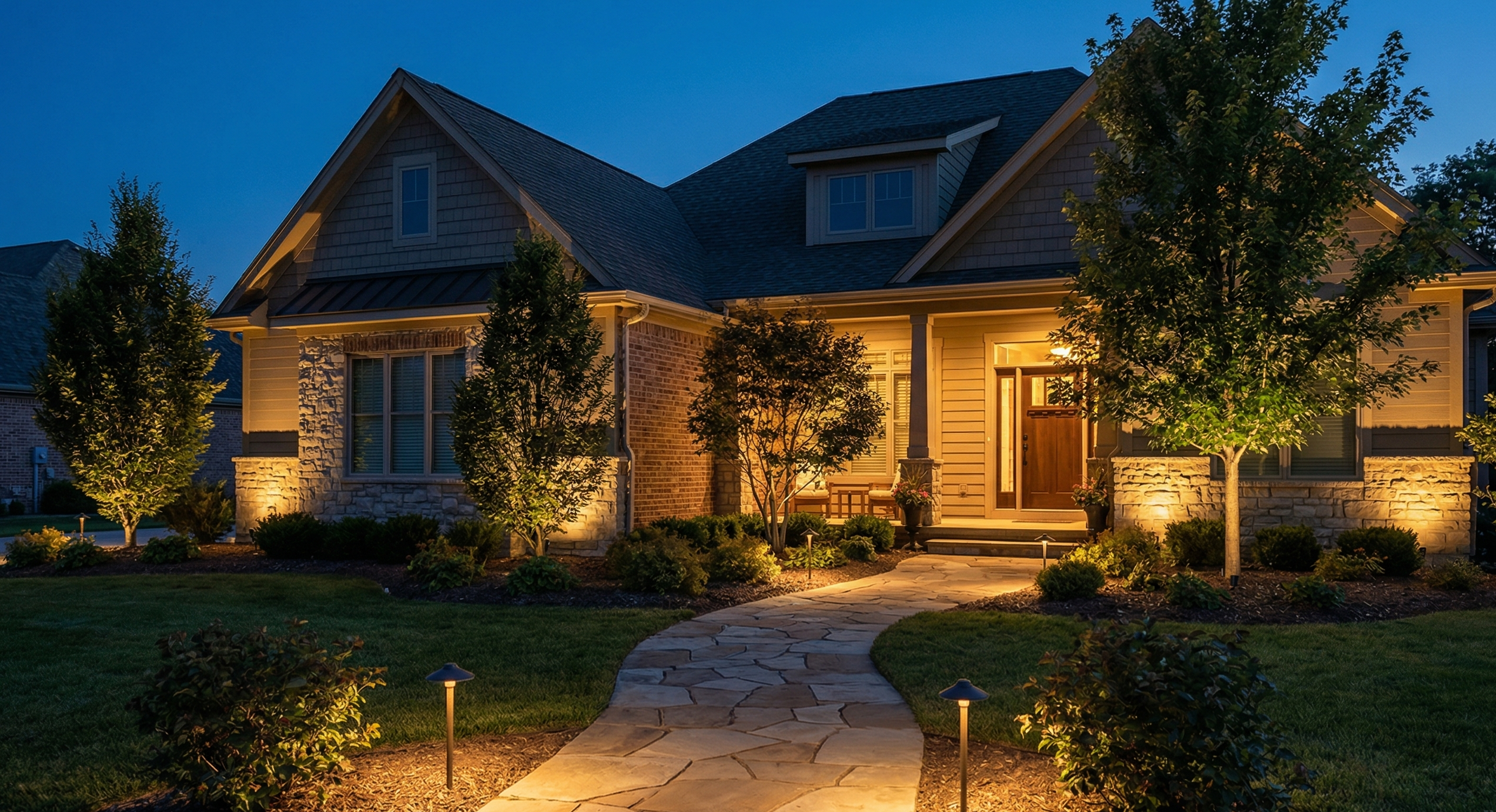
Landscape lighting should make your home look better at night than it does during the day. That is the whole point. But when it is done wrong, lighting can actually make a property look cheap, cluttered, or just plain strange.
The frustrating part? Most of these mistakes are easy to avoid if you know what to watch for. Whether you are planning a new lighting project or wondering why your current setup does not look quite right, this list will help you spot the problems and understand how to fix them.
Mistake 1: Using Too Many Lights
More lights does not mean better results. This is one of the most common mistakes homeowners make, especially with DIY kits that come with 10 or 15 identical fixtures.
When you line up lights every three feet along the front of your home, the effect looks like a runway, not a residence. The eye does not know where to focus because everything is lit the same way with the same intensity.
Good landscape lighting is about contrast. You want some areas lit and some areas in shadow. The interplay between light and dark is what creates depth, drama, and visual interest. When you flood everything with light, you lose all of that.
The fix is simple: use fewer fixtures and place them with intention. Light the features that deserve attention and let everything else fall into natural shadow.
Mistake 2: Ignoring Color Temperature
Color temperature is measured in Kelvins, and it determines whether your lights look warm or cool. Most landscape lighting professionals recommend staying in the 2700K to 3000K range, which produces a warm, amber glow similar to candlelight or a sunset.
Go too high (4000K or above), and your lights start to look bluish white. This is the color temperature you see in parking lots and gas stations. It feels cold and institutional, which is the opposite of the welcoming atmosphere most homeowners want.
Go too low (under 2200K), and the light can look orange or dingy.
The mistake happens when homeowners buy fixtures or bulbs without checking the Kelvin rating, or when they mix bulbs with different color temperatures across the same property. One warm light next to one cool light looks inconsistent and unplanned.
Stick with 2700K for most residential applications. It flatters brick, stone, wood, siding, and foliage equally.
Mistake 3: Aiming Fixtures at the Wrong Angle
A fixture that is aimed even slightly off can create problems. Point an uplight too far from a wall, and the beam misses the surface entirely, shooting light into the sky where nobody benefits from it. Aim it too close, and you get a bright hot spot at the base with nothing above it.
Spotlights aimed at eye level from across the yard create blinding glare that makes it uncomfortable to look in that direction. Pathway lights tilted to one side leave half the walkway dark.
Aiming is something that needs to be fine-tuned on site, ideally at night when you can actually see what the light is doing. This is why professional installers come back after dark on installation day to walk the property and adjust every single fixture.
At Serenity Outdoor Lighting, this nighttime walkthrough is a standard part of every project. It is not an extra step or an add-on. It is how we make sure the result matches the design.
Mistake 4: Creating Dark Voids Between Lit Areas
This one is subtle but it makes a big difference. Imagine your front facade is beautifully lit, and your backyard patio has a nice warm glow. But the side yard between them is pitch black. You walk from the front of your home to the back and pass through a dark tunnel.
These gaps between lit zones feel uncomfortable. They break the flow of your outdoor space and can even feel unsafe.
A good lighting plan accounts for transitions. You do not need to flood every inch of your property with light, but you do need gentle connections between zones. A few well placed pathway lights along a side walkway or a subtle wash on a fence line can bridge the gap without adding clutter.
The goal is to move through your property at night without ever feeling like you stepped into a hole.
Mistake 5: Choosing Cheap Fixtures That Will Not Last
Indiana weather is tough on outdoor fixtures. Summers bring heat, humidity, and thunderstorms. Winters bring freezing temperatures, ice, and snow. Spring and fall bring everything in between, sometimes in the same week.
Cheap fixtures made from thin plastic or low grade aluminum are not built to handle this. Within a year or two, plastic lenses fog up or yellow. Thin metal housings corrode. Seals fail and moisture gets inside, killing the LED chip.
You end up with a yard full of fixtures that look hazy, dim, or dead. And replacing them one at a time gets expensive fast, especially if the original fixtures are discontinued and the replacements do not match.
Professional grade fixtures made from brass, copper, or heavy duty aluminum alloys hold up to years of Indiana weather without losing their look or function. They cost more upfront, but they last. Every fixture Serenity installs comes with a lifetime manufacturer’s warranty because the quality supports it.
Mistake 6: Forgetting About the View From Inside
Most people plan their outdoor lighting by walking around the outside of their home. That makes sense. But they forget that they spend far more time looking out their windows than they do standing in the front yard.
If your lighting design looks great from the curb but creates harsh glare when you look out your kitchen window, you will notice it every single night. A spotlight aimed directly at a tree that sits right outside your living room can turn that window into a wall of white light.
The best designs consider both perspectives. How does the lighting look from the street? And how does it look from the rooms where you spend the most time? Fixtures can be positioned and aimed to look beautiful from outside without creating glare problems inside.
This is one of those details that separates a thoughtful design from a careless one.
Mistake 7: Skipping the Design Phase Entirely
This is the biggest mistake of all, and it is the root cause of most of the others on this list.
Some homeowners buy a box of lights, walk around the yard, and start sticking fixtures in the ground wherever it seems like a good spot. Some contractors do the same thing, just faster.
Without a design plan, you end up with random placement, inconsistent spacing, no thought given to technique selection, and no strategy for how the whole property comes together as a unified look.
A proper design starts with studying the property during the day: the architecture, the landscaping, the sight lines, the features worth highlighting, and the areas that need functional light. Then the designer selects the right technique (uplighting, downlighting, path lighting, accent lighting) for each zone and chooses fixtures that fit.
The design phase is where the value lives. The installation is just the execution of a plan that has already been thought through.
How to Tell If Your Current Lighting Has These Problems
Walk outside tonight after dark and look at your home from the street. Then walk through your yard from front to back. Then go inside and look out your most used windows.
Ask yourself a few questions:
Does the lighting look intentional, or does it look like fixtures were placed randomly? Are there dark gaps between lit areas? Do any lights create glare or hot spots? Does the color of the light feel warm and inviting, or does it feel cold?
If something feels off, it probably is. And the good news is that most of these problems can be fixed without starting over. Sometimes it is a matter of repositioning fixtures, swapping bulbs, or adding a few lights in the right places to fill gaps.
Get a Lighting Plan That Avoids Every One of These Mistakes
The easiest way to avoid all seven of these mistakes is to start with a custom design from a team that does this every day. At Serenity Outdoor Lighting, we design every project specifically for the property in front of us. No generic layouts. No guessing.
If you want to see what a well planned lighting design looks like on your home, reach out for a free quote or contact us to get started.
